Sep 7, 2018 | Law News, Ozmon Law News
gavel and stethescope on white background
My blogs this summer have touched on a recurring theme, how a plaintiff’s contributory negligence can diminish or defeat her case. As the best time of year to be in Chicago comes to a close, I have to bring this discussion full circle with one final observation I see in the great outdoors—the survival instinct is dying. And this evolutionary change will be judged in a courtroom.
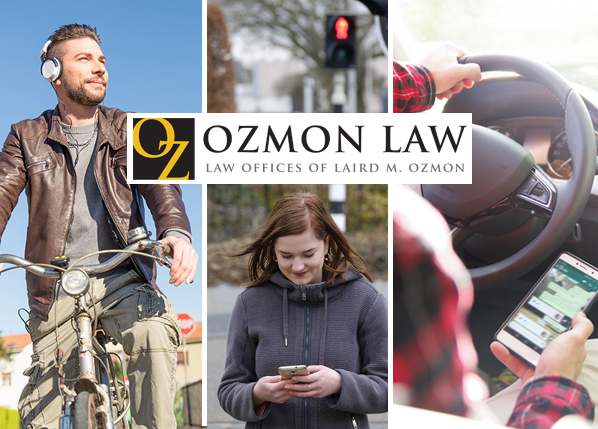
You know what I’m talking about, it’s everywhere. Bikers wearing headphones, pedestrians looking at their phones oblivious to their surroundings, drivers texting, no one in the roadway using signals. I admit, I’m a student of the “old school” that taught engaging the human senses as a matter of life and death. “Stop. Look. Listen.” “Look both ways when you cross the street.” This is not just the stuff of Darwin, it’s what we learn in kindergarten. So why are people so willing to render themselves, deaf, dumb and blind and blithely entrust their well-being to the rest of the population?
While this cultural phenomenon did not start with the Smartphone (remember the Walkman?), it has proliferated in that tiny, powerful technological device. Studies have shown accidents due to distraction are on the rise: https://www.usatoday.com/story/money/cars/2018/02/28/pedestrian-fatalities/376802002/. Those who are so dependent on it, so addicted to it or the magnitude of distraction it provides, that they cannot tear themselves away need to . . . “step away from the phone.”
Illinois law does not allow you to relinquish responsibility for yourself and your own safety; thus the contributory negligence defense. For instance, if you are so busy looking at or talking on your phone that you enter an intersection without looking both ways or obeying a traffic control device, you will likely be found more negligent than the driver who hit you. Your mobile phone is no longer your closest confidante, it is a storage device for potential evidence against you, i.e. the time you sent or read a text, when you were on a call, etc. After being struck on your bicycle in the middle of the street, if you are found wearing earbuds or headphones (the noise-cancelling ones are really just insane), the driver who honked his horn as he was properly approaching when you made a sudden lane change may not be held responsible. All of this means you may not recover for your injuries because you were contributorily negligent.
So here’s my pitch, as a father, not a plaintiff’s attorney: reengage your senses.
STOP! Take in the world around you. LOOK! Use your eyes, not only to protect you from imminent danger, but to see that smiling stranger, carefree dog, or sunset. LISTEN! Use your ears, to hear warning signs or vehicles approaching, and the talented street musician, or old friend calling from across the street or train platform. I would be happy knowing you took this advice so you never needed my legal advice.

Attorney Laird M. Ozmon
Aug 21, 2018 | Law News, Ozmon Law News

Construction accidents typically occur due to someone’s negligent actions. Negligence occurs when something is done that a reasonably careful person wouldn’t do, or when something isn’t done that should have been. Damages to the person affected may include pain, suffering, disability, disfigurement, medical expenses, and loss of income. If you’re the victim of a construction accident, here are 3 things you should do.
- Seek medical attention immediately. This will document any injuries so that the evidence may be used at a later date. Don’t ignore medical treatments or doctor visits, and follow the prescribed treatment and medication plans. Failure to do this can have a negative impact on any potential financial compensation. Delaying medical treatment can have a similar negative impact, as the seriousness of the injuries will be in question.
- Preserve any evidence, and gather all relevant facts and documentation. Take photographs of any serious injury or damage caused by a construction accident. Create a written summary of the facts of the accident, including how and when it occurred, the type of injury, expenses lost, and any related insurance and medical information. Document any witnesses to the accident, and request a copy of police reports and any incidence reports.
- The most important thing you can do if you’re the victim of a construction accident is to contact a personal injury lawyer to help build your negligence case. Laird Ozmon, a personal injury attorney based in Joliet, has dedicated his practice solely to the representation of seriously injured victims and their families for over 30 years, and handles cases locally, regionally, and nationally as a top trial lawyer. After seeking medical attention, contact Ozmon Law before speaking with or providing any recorded or written statements to insurance companies or anyone related to the construction company. Don’t ever sign any legal or medical documents prepared by an insurance company, the construction company, or their lawyers without the presence or consent of your own personal injury lawyer.
Attorney Laird M. Ozmon
Aug 1, 2018 | Law News, Ozmon Law News

In my last blog I touched on the concept of a plaintiff’s negligent conduct that can often derail his case and deflate expectations of a recovery. This is called contributory or comparative negligence, and, in the worse case scenario, it can be fatal to a plaintiff’s case.
Illinois is a modified comparative fault state. This means if an injured victim is determined to have been negligent and that negligence contributed, along with the defendant’s negligence, to cause the injury, the plaintiff’s recovery will be reduced. The jury must determine the percentage of negligence attributable to the plaintiff. Any recovery awarded to the plaintiff will be reduced by this percentage. BUT, and this is a big one, if the plaintiff is found to be more than fifty percent negligent, the plaintiff will recover nothing.
In my experience defendants will raise the specter of contributory negligence even if there is no evidence to support it. It is my job to keep this cancer out of the courtroom and out of the minds of jurors when the defendants have not complied with Illinois law in raising the issue. I’m a fierce advocate when it comes to filing pre-trial motions seeking to bar this evidence.
Illinois law requires the defendants to plead contributory negligence when they answer the plaintiff’s complaint in what is called an affirmative defense. If they don’t, then the law mandates they be barred from bringing the issue of blaming the victim before the jury. Ultimately, the defendant must offer evidence to support the contributory negligence affirmative defense, if they fail to do so, they cannot raise the issue before the jury.
This rarely deters defendants who masquerade it as something else. They claim the evidence that the victim of malpractice failed to follow-up with their physician is benign evidence describing their course of treatment and unrelated to their own negligence. Or they throw out an amorphous allegation unsupported by the evidence that a slip and fall victim failed to keep a proper lookout or exercise due care.
In the recent case of Lakin v Casey’s Retail Company, the Illinois Appellate Court sided with the plaintiffs. It affirmed the trial court’s refusal to allow the defendants to instruct the jury the plaintiff had the burden of proving he was not guilty of failing to keep a proper lookout or exercising proper care when he slipped and fell in a store. The court admonished the defendants for not pleading any facts beyond the vague and conclusory allegations of failure to keep a proper lookout or to use proper care that would substantiate contributory negligence. As plaintiff’s attorneys we must be vigilant in defusing this nefarious “blame game” seeking to shift responsibility to our clients who are innocent victims.
Attorney Laird M. Ozmon
Jul 23, 2018 | Law News, Ozmon Law News

It’s a jungle out there. In the spirit of environmental consciousness our highways and byways are filled with bikes and scooters, E-bikes and motorized scooters, mopeds or skateboards, all in a state of frenetic locomotion. In my practice I have found these non-traditional vehicles, motorized or not, generate confusion concerning the rules that apply to them and how Illinois law treats a rider who is injured in accident.
The basic premise for anyone operating a vehicle on an Illinois roadway is they must follow the Rules of the Road—that means you: bikers, motor scooters, skateboarders, etc. So don’t think you can blow a stop sign at a 4-way intersection when a car gets there first. Yes, there is etiquette, for our non-traditional vehicles, a driver’s nod of recognition or a wave of the hand means she cedes the right of way to you. Notwithstanding this, you must always protect yourself by expecting to be treated like any other vehicle on the road even though you don’t have two tons of steel wrapped around you for protection.
All non-traditional vehicles must follow sidewalk rules. The general rule is, if its motorized, it is not allowed on the sidewalk. Think of your mom exiting the door of your local bakery and getting wiped out by a Boosted Board traveling at 20 miles per hour.
State law does not explicitly prohibit bikers from riding on sidewalks. Local ordinances dictate the rules. Some have age limits, others allow it in certain areas and prohibit it in others as dictated by signage. In all cases, when riding on the sidewalk, remember pedestrians have the right of way and the law protects them over riders. Of course, the proliferation of bike lanes has added a new wrinkle and pedestrians (and parked cars) must heed the markings specially dedicated to bikes.
With the invention of new and faster vehicles, i.e. Boosted Boards (motorized skateboard) and One-Wheels (motorized platform with a wheel), the definition of a vehicle and the rules that apply to it are more muddled. For instance, in the City of Chicago it is illegal to ride a skateboard on a roadway or sidewalk in a business district. Chicago Code, 9-80-200. The Illinois Vehicle Code defines a “business district” broadly where there is a roadway with buildings in use for business or industrial purposes within any 600 feet. Although the ordinance is not specific, this likely prohibits use of a motorized skateboard, or similar vehicle, on a street in a city business district. There goes your new ride to work!
Not following the rules that apply to you has consequences in the context of a claim or lawsuit following an accident. If you are considered more than 50% at fault, your recovery is barred. This means even if someone is found to have been 49% negligent when they struck you on your E-bike, you cannot recover any money. If you violate an ordinance or statute that is designed to protect human life or property, like the above skateboard example, that is presumptive evidence of your negligence, and potentially weakens your case. So for everyone’s sake, lose the earbuds, follow the Rules of the Road and sidewalks, protect yourself and watch out for others.
Attorney Laird M. Ozmon
Jun 27, 2018 | Ozmon Law News

Often when people are injured they have difficulty articulating their injuries. It’s usually a case of underreporting (failing to mention the MRI you had) or over reporting (trying to blame every ache and pain on the injury). My decades-long career as a plaintiff’s attorney has afforded me an ability to ask the right questions in order to gather the most relevant information. I then am able to assess all of the potential damages to which a plaintiff may be legally entitled to recover in a lawsuit. This process not only helps clients to know their rights but also to have reasonable expectations as to the amount of money they may expect to recover.
The law is very specific about the damages that are recoverable in a personal injury case. If the case goes to trial, the jury is instructed on the elements of these damages and plaintiff’s attorneys structure their closing arguments to seek an amount for each of these elements of damages which when totaled makes up the jury’s award. Similar arguments are informally made between lawyers attempting to settle a case.
Some damages are much easier to value than others. For instance, it is easy to seek reimbursement for all paid medical expenses related to the injury. This is a fixed amount supported by medical bills. It is more difficult to assess damages for future medical expenses, like a surgery that won’t become necessary for five years, but is nonetheless related to the claim. Here we have to seek the testimony of medical experts to support such a claim.
Likewise, lost wages for a fixed period off work after the incident are calculable, but if the plaintiff cannot return to work, we need to extrapolate a lifetime of loss using life expectancy tables and the future growth of earnings to calculate the future loss. In many instances, an economist is retained as an expert to explain the complex calculations.
Then there are less tangible elements of damages including: pain and suffering, loss of a normal life/disability, disfigurement. Victim’s loved ones may also suffer losses as acknowledged by the law. These are separate causes of action such as loss of consortium or loss of society in a wrongful death case. These damages focus on losses sustained by certain family members as a result of what a plaintiff is no longer able to do, i.e. give love, comfort, support or advice to a spouse, child or parent, and how this affects those loved ones.
The amount of money that may be recovered for each of these elements is highly subjective and determined by a unanimous jury’s verdict. For instance, a juror who suffers from a chronic pain syndrome may attribute a much greater value to pain and suffering than a 22 year-old healthy male who can’t relate. Or, conversely, the juror with the chronic pain syndrome may be reluctant to award money when they never received anything for their problems. These elements of damage are critical to the plaintiffs case and I spend a significant amount of time and energy developing them. This may involve interviewing loved ones, friends, colleagues, co-workers, clergy and/or consulting experts. Significant recoveries by plaintiffs result from well-supported and compelling evidence as to these elements of damages
Making the case for damages is the final and most important chapter in the plaintiffs story. Over my nearly 40 years of trial experience, I have always focused on making that chapter end with my plaintiff’s recovering the maximum fair and just compensation from the jury.
Attorney Laird M. Ozmon